Showing posts with label Housing Bills. Show all posts

Sunday, April 29, 2018

Liang - Action Plan and Timeline to fulfill RHNA allocation all income categories

From: Liang
Date: Fri, Apr 20, 2018 at 9:33 PM
Subject: Action Plan and Timeline to fulfill RHNA allocation all income categories
To: Aarti Shrivastava <AartiS@cupertino.org>, David Brandt <davidb@cupertino.org>, City Attorney's Office <CityAttorney@cupertino.org>


Dear Aarti and David,

The first reporting period for this Housing Element cycle will end by the end of this year.

Under SB 35, HCD would now require Cupertino to pull permits for at least 50% of units in all income categories.
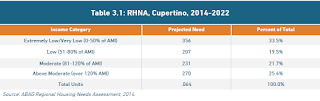


I wonder what is the city's action plan to fulfill that 50% requirement in each income level so that we are not subject to SB 35 next year. In other words, what is our action plan to approve and permit 178 EVL/VL units, 104 Low units, and 116 Moderate units?

What options we have and what financial burdens each option will put on the city and taxpayers?

If the city has studied this issue and has an action plan, please point me to any such document or meeting minutes.

I've looked through the Housing Element and I couldn't find a clear plan to provide the BMR housing numbers in the RHNA allocation.

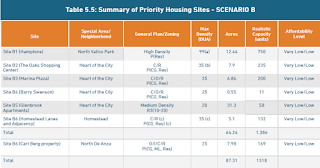
From the Appendix B of Housing Element Technical Report, I see that the city marked every site in Scenario A as "Very Low/Low":


The city has approved Hamptons and Marina projects, total 600+188 units. But they only provide a small fraction of the "Very Low/Low" units. So, I wonder whether the city has a plan to actually provide BMR at all income levels in RHNA requirement?

I noticed the letter at the end of Appendix B from Low Foundation of Silicon Valley. The letter points out:
  • There is no analysis as to why housing production in Cupertino for low-income individuals and families fell nearly 90% short of its affordable housing allocations under the past planning period's RHNA.
  • In general, the qualified objectives and housing programs currently in the Housing Element lack specific time frames or actions, and require changes to make them effective tools for development.
  • The Draft's programs lack meaningful timeframes, which makes it difficult to determine whether the programs will have beneficial impacts during the planning period. State law requires that the Draft contain programs that set forth a schedule of actions during the planning period, each with a timeline for implementation, such that there will be beneficial impacts of the programs within the planning period. (Government Code § 65583(c).)
  • Cupertino's programs also lack clarity and specificity, which makes is extremely difficult for members of the public to understand what steps Cupertino will take to achieve its goals and how and when the public can engage with Cupertino staff. Per HCD, "programs must include a specific time frame for implementation, identify the agencies or officials responsible for implementation and describe the jurisdiction's specific role in implementation." (Housing Programs: Conserve and Improve the Existing Housing Stock, Required Components of Program Actions, http://www.hcd.ca.gov/hpd/housing_element2/PRO_conserve.php.)
Looking through Chapter 4 Housing Element and Appendix B Housing Element Technical Report, I did not find any "specific time frame for implementation" or "actions" to deliver the "356 extremely low/very low-income units, 207 low-income units, 196 moderate-income units" within the 8 years of Housing Element cycle.

Thank you for your attention to this matter.
Now that several 2017 pro-housing laws, including SB 35, have passed, I wonder what's the city's plan to fulfill RHNA requirements? What has been done? What's planned for 2018 or the next 4 years, remaining in the current HE cycle.

Sincerely,

Liang
Cupertino Resident

Monday, April 23, 2018

Liang to Senators - Unintended Consequences With SB 35, Which Will Be Amplified by SB 828

From: Liang
Date: Mon, Apr 23, 2018 at 3:20 PM
Subject: Fwd: Unintended consequences with SB 35, which will be amplified by SB 828
To: <senator.beall@senate.ca.gov>, <sunshine.borelli@sen.ca.gov>, Anthony Cannella <senator.cannella@senate.ca.gov>, <tyler.munzing@sen.ca.gov>, <senator.dodd@senate.ca.gov>, <marisol.prietovalle@sen.ca.gov>, <senator.gaines@senate.ca.gov>, <matt.cox@sen.ca.gov>, <senator.galgiani@senate.ca.gov>, <taylor.wollfork@sen.ca.gov>, <senator.mcguire@senate.ca.gov>, <carole.mills@sen.ca.gov>, <senator.morrell@senate.ca.gov>, <scott.terrell@sen.ca.gov>, <senator.roth@senate.ca.gov>, <matthew.montgomery@sen.ca.gov>, <senator.skinner@senate.ca.gov>, <melanie.morelos@sen.ca.gov>, <senator.vidak@senate.ca.gov>, <lyndsay.mitchell@sen.ca.gov>, <senator.wieckowski@senate.ca.gov>, <evita.chaves@sen.ca.gov>,  <senator.wiener@senate.ca.gov>, <annie.fryman@sen.ca.gov>

The intent of SB 35 is to keep the city accountable for RHNA allocation. Good intention. But that doesn't make it a good law. The devil is in the details.

The RHNA allocation has been viewed as guidelines, not a requirement by the cities.
Is that the fault of the cities? Or is that the fault of HCD for not making the intent clear?

It is good to have some "sticks" to ask the cities to become accountable for RHNA allocation.
But the law is just passed and they are putting the cities in very difficult situation.

Here are the problems with SB 35.

1. SB 35 should not change the requirement in the middle of the current Housing Element cycle: The law only counts units permitted, not units approved.
Cupertino has already approved 62+188+600+19 = 869 units out of the 1064 units allocated.
Unfortunately, the city did not set a shorter deadline for developers to pull permits. The project approval is good 10 or 15 years. SB 35 basically punishes Cupertino for being proactive by approving 869 units within the first 2 years of the Housing Element Cycle. Now we cannot go back and shorten the duration for the project approval or a shorter deadline for pulling permits. We are stuck with these 188+600 approved units if the developers don't want to build yet. Basically, the state changed the rule in the middle of the Housing Element and now expect the city to meet a much stricter requirements.

2. SB 35 only respect "objective standards", but ignore the rest of the General Plan.
The intention is to give the developers clearer standards to follow. Good intention. But again. The law did not give the cities time to review our General Plan to clarify certain policies with objective standards. Cupertino intentionally does not set standard for Vallco to give the developers freedom to propose a project. The Vallco area has no height limit. The office space of 2 million square feet was meant to be provisional, subject to community inputs and council approval.
In no one's mind is 2 millions square feet is a proper amount for Vallco, it was meant to be a placeholder for consideration, pending Vallco Specific Plan through community engagement and adopted by the city council.
But SB 35 all of a sudden took away the right of the council to decide on the proper amount of office space. Now, the developer not only gets to streamline the residential portion of the project, but also the massive office portion.

3. SB 35 did not specify what counts as the "square footage" for "residential use"?
What's funny is that SB 35 itself did not define objective standards for "square footage" for "residential use"?

In the Vallco SB 35 application, they claim 4.7 million sqft residential use in order to justify for close to 2 million sqft office space. In fact, the total residential rooms only account for 2.2 million sqft. The other 2.5 million sqft include rooftop park, rooftop swimming pool, unusable space under the rooftop, and residential parking, all of which should not be included in "residential use", especially when office and retail parking are NOT included in the total square footage. Ironically, SB 35 itself doesn't not have objective standards on what counts as "residential use".

This begs the question: is it at all possible to specify everything in objective standards and not allow the city council to interpret its own law when its not clear? (Per SB 1515) 

4.  SB 35 illustrates the flaw for using state laws to attempt to overwrite local planning decisions since there are many small details that vary from city to city. The general plan is derived from state mandated public process. Yet, now SB 35 attempts to wipe most of the standards away for projects even with 10% BMR units.

5. The developers are in control on what projects to propose; when to build, not the cities. With SB 35, developers will NOT propose projects or pull permits until the cities are designated as SB 35. Then, the developers can submit a very dense SB 35 application as a threat, not even intending to build the BMR or pay prevailing wages. (The developers get to claim three exceptions to increase beyond the general plan specified, on top of the density bonus) Then, they pressure the city to give them approval of a non-SB 35 Plan with much higher density than previously allowed. That's exactly what Sand Hill is doing in Vallco. 

There three other developers in Cupertino waiting to use the same strategy. Two with projects already approved in 2016. But they'd rather wait for more pro-housing bills that they can use to push for more density and less fees or benefits to provide.

6. There is no requirement that the streamlined project can't be divided up and sold off individually. Very likely, the developers will sell off the more profitable parts like office and market-rate housing. Then, they might come back to the city and say that they can't find the BMR units.

7. There is no time limit on when a streamlined SB 35 projects need to be completed or whether they need to develop the BMR portion or secure funding for BMR portion first. A developer could get a streamlined SB 35 project to pass and then sit on it or sell it to the highest bidder piece by piece.

There seems to be nothing in SB 35 that holds the developers accountable to deliver the streamlined projects in a timely manner, especially the BMR portion.

A "good idea" or a "good intention" doesn't make a good bill. The devil is in the details.

Now SB 828 to be discussed in the Senate Housing and Transportation Committee tomorrow will sharpen the edge of SB 35. The Senate should really slow down and examine the impact of 15 pro-housing bills from 2017. More "good ideas" that are not well thought out would simply create more bad ideas.

And with development projects, the damage is often irreversible since each project will last 50 years or more.

Friday, April 20, 2018

Liang - CaRLA sued Sausalito and won.

From: Liang
Date: Fri, Apr 20, 2018 at 1:59 PM
Subject: CaRLA sued Sausalito and won.
To: City Council <citycouncil@cupertino.org>, City of Cupertino Planning Dept. <planning@cupertino.org>


Dear Mayor Paul, City Council members, City Manager Brandt and the planning staff,

It's been 6 months since the passing of 15 pro-housing bills in September 2017. What's the city's plan to strengthen our Municipal Code and the General Plan with objective standards do that vague and subject standards could be replaced with objective standards?

The legislators did not forbid the cities from adopting new objective standards to clarify vague subjective standards. The intent is in fact more objective standards for the developers to follow.

What's our plan to provide clear object standards to developers and homeowners?

The enclosed case is a lawsuit over one additional housing unit because the city rejected the project without using objective standards. How likely will CaRLA sue Cupertino over similar cases? Do we have sufficient objective standards in place to protect our residents and the city over such lawsuit?

SB 831, which passed the Senate Housing and Transportation Committee on 4/17, will likely move forward and get approved. It will remove the right of the city to regulate the backyards of every single-family home in Cupertino. People could put several units of ADU with little setback, no parking and not paying any impact fees.

The city should assess the impact of SB 831 and looking at possibly strengthening Cupertino's Municipal Code by December 32, 2018, before SB 831 is signed into law.

Thank you.

Sincerely,

Liang
Cupertino Resudent 
From: CaRLA <hi@carlaef.org>
Subject: We sued Sausalito. And then we won.
Date: Friday, April 20, 2018 10:14:26 AM PDT
Reply-To: CaRLA <hi@carlaef.org>


California Renters Legal Advocacy and Education Fund

We sued Sausalito. And then we won.

Today we are announcing a final victory in our Housing Accountability Act lawsuit against Sausalito for an unlawful denial of a housing project. In 2016, David Holub, the owner of the project at 77 Crescent Avenue, proposed a modest addition to his property that would add one new unit of housing to the Bay Area's already scarce housing supply. On September 11, 2017, Sausalito City Council voted to deny David's project.

Today, our lawsuit against the City of Sausalito was dismissed as part of settlement proceedings. The City of Sausalito approved the housing project, reversing its previous denial. After the lawsuit was initially filed, the City of Sausalito attempted to circumvent their obligations under the state's Housing Accountability Act by approving a reduced, infeasible project. CaRLA fought back, resulting in David Holub receiving a final approval for a slightly modified project with the same square footage which will ultimately result in one additional unit of housing added to the Bay Area's already scarce housing supply.

The City of Sausalito denied the project on the grounds that the project is "out of scale with the village like quality of Sausalito". We alleged that the city's reason for denial of the project was based on subjective criteria, which is a violation of the Housing Accountability Act's requirement that projects can only be denied for objective, legally-defined criteria; the organization prevailed as the city saw no alternative but to settle.

Today, the City of Sausalito learned a valuable lesson: No suburb is safe from the watchful eye of CaRLA. In its majestic equality, the law forbids rich and poor cities alike from denying the human right to housing. When the State of California fell short on its enforcement responsibilities, CaRLA was there to secure the human right to shelter for all. We will remain vigilant as always in our work to reign in malicious municipalities intent on restricting this right to only those with the most means.

We've recouped attorneys' fees as part of the settlement, putting other cities on notice that there are material consequences to violating state housing law. As CaRLA continues to enforce state housing law, cities across the state are beginning to see the writing on the wall and opting to avoid lengthy trials by reversing these unlawful denials early on, further expediting much needed additions to the state's housing supply.

"CaRLA rescued me from an unlawful denial of my project," adds applicant David Holub, "Until they showed up I was entirely on my own against neighbors and politicians determined to negate my property development rights. Their Housing Accountability Act law suit compelled the City of Sausalito to treat my applications fairly, entirely in conformity with the applicable codes, as they should always have been treated, but unfortunately never were."
Read More

Our support is free. Help keep it that way.

CaRLA is sustained by your charitable contributions. If you would like to see us continue our work, please consider joining our growing list of supporters with a monthly subscription.
Donate Today
Copyright © 2018 CaRLA, All rights reserved. 
You are receiving this email because you opted in via our website. 

Our mailing address is: 


Want to change how you receive these emails?
You can update your preferences or unsubscribe from this list. 

Email Marketing Powered by MailChimp

Tuesday, March 6, 2018

Ignatius - Agenda Item #18 -- Objection to SB 827

From: Ignatius D
Date: Tue, Mar 6, 2018 at 5:12 PM
Subject: Agenda Item #18 -- Objection to SB 827
To: Cupertino City-Council <citycouncil@cupertino.org>
Cc: "Grace Schmidt CMC (City Clerk)" <CityClerk@cupertino.org>, David Brandt <manager@cupertino.org>, City Attorney's Office <CityAttorney@cupertino.org>


* * *  Please enter this email letter into public records * * *  Thank you!!

Dear Mayor Paul and members of the City Council,

I urge you to send a strongly worded letter of objection to the California Senate to reject the consideration and passage of SB 827 which would grossly deprive the rights of city governments throughout the state to plan, regulate and manage certain developments near those vaguely defined "transit centers" or "bus stops" with "frequent stops."

This would not only violate the zoning rights of local governments, which is a part of the bedrock of our decentralized democracy dating back even before the U.S. Constitution was written, but also give the unlimited opportunities to unaccountable developers to define and develop housing units that might cause a humongous amount of environmental harm, especially traffic congestion and air/water pollution, than good without legally required CQEA evaluation and mitigation and proper check and balance enforced by the local authorities.

Please send our collective objection to Sacramento and join the California League of Cities and other cities across the state to fight the unwarranted imposition from the Capitol by all means necessary.

Thank you for your attention.

Ignatius D
Cupertino Resident of 41 years ​

Liang - Many Reasons to Oppose SB 827. No Amendments Acceptable.

From: Liang C
Date: Tue, Mar 6, 2018 at 4:02 PM
Subject: Many Reasons to Oppose SB 827. No Amendments Acceptable.
To: City Council <citycouncil@cupertino.org>


Dear Mayor Paul and City Council Members,
I urge you to take the leadership to take a strong stand opposing SB 827. No amount of amendments to SB 827 would fix such a bill based on wrong assumptions and do not even increase any supply of below-market-rate housing.
The 2017 pro-housing bills also include some aggressive measures to ensure that the cities would meet the RHNA allocation; otherwise, they will face severe consequences. The cities should treated like adults. Set a goal and then enable the cities to achieve that goal. The cities should not be treated like little children so that the state has to dictate how the city would zone its lands to achieve the RHNA goals.

Each city has diverse needs and situations. What's suitable for San Francisco may not be suitable for the entire California. What's suitable for Cupertino should be determined by the City Council and its residents, not a one-size fits all policy. The impacts of wrong land use decisions are irrevocable for 50 or more years. Please strongly oppose SB 827 and similar bills that take away local control on land uses.
Below are 13 reasons to oppose SB 827.

Senate Bill 827, if passed, automatically upzones all neighborhoods within a ½ mile radius of a major transit stop or a ¼ mile radius of a bus stop with frequent service to unlimited density and floor area ratio with height limits of 55 feet high (5 stories) to 85 feet high (8 stories) for wider roads. (And 35% higher when density bonus applies)
Any bus running every 15 minutes during any rush hour is considered “frequent” by SB 827.
SB 827 eliminates setbacks, residential density, parking requirements, or any standard that limits density.

1. SB 827 is an environmental disaster. Loss of open space; loss of solar power generation; increased depletion of aquifers; greatly increased air pollution from increased traffic congestion; Increased impacts from global warming; increased risk of flooding.
2. SB 827 punishes responsible local governments and rewards irresponsible local governments. Irresponsible local governments have encouraged runaway office growth with inadequate housing for out-of-town workers.
3. SB 827 encourages the removal of existing affordable housing in order to build higher-cost housing. SB 827 does not require additional inclusionary below-market rate housing. Right-to-remain after eviction is of little use for most.
4. Real estate construction interests and big tech corporations back SB 827 for their financial benefit and at the expense of the quality of life for residents. The bill’s main author has taken large campaign contributions from these entities. SB 827 enriches for-profit real estate and construction interests.
5. SB 827 demonstrates a misunderstanding of the purpose of the general plan as a city’s guiding policy document for land use change and a blatant disregard for the role of community involvement in the democratic process. Zoning needs to be left to local planning experts with public engagement.
6. SB 827 deprives municipalities of the ability to provide sufficient subsidized below-market-rate (BMR) housing. It takes away the primary tool available to the city officials: the authority to upzone and regulate development standards. SB 827 is not only oblivious to the expenses the cities will incur to provide infrastructure, but also took away any ability for the cities to recover any infrastructure impact fees.
7. SB 827 will overload already extended infrastructure in overcrowded areas. The cities will face rising pension cost, rising infrastructure cost due to rapid increase in population and rising cost to provide subsidized BMR housing. SB 827 does not require additional percentage of BMR housing.
8. SB 827 absolves corporations of their responsibility to own the housing insecurity they cause when building offices in communities with insufficient housing. Corporations have recruited significant numbers of tech workers from out of the state into an area with an existing severe housing shortage.  This disproportionate number of imported workers has driven up housing prices and displaced local residents.
9. SB 827 does not require cost savings for developers from higher density be passed on to tenants. It eliminates max unit counts, parking requirements, and other zoning regulations under the guise that density will lower housing costs. Property owners are given a pass to charge market-rate rents.
10. SB 827 will undermine effective transit with sufficient ridership in the long run. Large amount of attractive public places, retail, shopping, service-providing businesses do generate transit ridership, not housing. Years of market-rate housing with token retail near transit in LA has seen decreased transit ridership.
11. SB 827 will create dangerous traffic conditions near transit due to no parking requirement. The streets near transit will become parking lots while the commuters also seek parking in these streets. These streets become more dangerous for pedestrians and bicyclists who take transit.
12. SB 827 will affect schools severely by adding large numbers of students with no space and little funding. There is no chance to negotiate additional fees or taxes to fund land acquisition for new schools, or new construction at existing school sites, which often cost $50+millions.
13. SB 827 will result in more luxury apartments in the most-expensive areas, but little housing in affordable areas. As many areas are upzoned at the same time by SB 827, developers get to choose where to build to make the most profit.


Sincerely,

Liang C
Cupertino Resident

Tara - Opposition of SB 827

From: Tara S
Date: Tue, Mar 6, 2018 at 2:15 PM
Subject: Opposition of SB 827
To: Cupertino City-Council <citycouncil@cupertino.org>


Dear Mayor Paul and Councilmembers,
I'm writing to urge the Cupertino City Council to affirm its opposition of SB 827.

While we can all agree that it makes sense to build housing near transit, it should not be to the detriment of our communities. SB 827 is an extreme proposal that could intensify displacement – it is a sledgehammer approach that threatens existing communities.
SB 827 strips local government officials and community members of their ability to appropriately plan for future development. Instead, SB 827 gives developers, who are unaccountable at the local level, the power to exempt themselves from locally developed and adopted building height limitations, densities, parking requirements, and design review standards.

It is important to note that under existing law, cities are already required to zone for densities at levels necessary to meet their entire Regional Housing Needs Allocation (RHNA).
The City of Cupertino’s General Plan promotes walk-able and bike-able communities as we move towards building transportation infrastructure that doesn’t require single-occupancy cars. Planned Development Areas (PDAs) account for 80% of our future housing needs and include properties within a quarter mile of Stevens Creek Boulevard from Highway 85 to its eastern border and a portion of North and South De Anza Boulevards which currently allow for 25-35 units per acre.
Some in our community are worried that transit agencies risk influencing land use decisions by adding or changing bus routes either intentionally or unintentionally. 

SB 827 allows private for-profit housing developers to determine housing densities, parking requirements, and design review standards within one-half mile of a “major transit stop,” or along a “high-quality transit corridor” which could be miles away from an actual bus stop.  Additionally, housing developments within these areas can range in height between 45 feet and 85 feet depending on the desire of the developer.
This bill threatens local land use plans that cities work so hard to encourage while also not addressing our affordability crisis. SB 827 would undermine locally adopted General Plans, Housing Elements (which are certified by the Department of Housing and Community Development), and Sustainable Community Strategies (SCS). 


--
Thank you,
Tara S

Monday, March 5, 2018

Liana - Request to Send Letter Opposing SB 827

From: Liana C
To: Cupertino City-Council <citycouncil@cupertino.org>
Sent: Monday, March 5, 2018, 11:09:07 AM PST
Subject: Request to Send Letter Opposing SB 827, Council Meeting 3/6/2018, Agenda Item 18; Support Letter of Opposition Against SB 828, Council Meeting 3/20/2018, future agenda item

Dear Mayor Paul, Vice Mayor Sinks, and Council Members Chang, Scharf, and Viadhyanathan:

As the authority of the Legislative Advocacy Committee (LAC) has been dis-proven for now via information revealed in a California Public Records Act request (relevant letter with documents included at the end of this message) and now an entire month has passed since community members and/or Council Members have started asking the City for action against predatory State Bills 827 and 828, I am forwarding the letter I sent previously to the then LAC for the full Council's consideration of now Agenda Item 18 "Transit-rich Housing Bonus" to be decided during 3/6/2018 City Council meeting (see letter immediately below).

I support the recommended action stated in the 3/6/2018 meeting agenda: "Oppose SB 827 (Weiner, sic) and authorize the Mayor to send letters of opposition to state legislative leaders along with our state delegation."

And, I request that Council consider drafting a letter opposing SB 828 (Wiener) "An act relating to land use" as an action to be deliberated during the 3/20/2018 regular Council meeting.

Regarding a LAC, I'm not sure why the Council would abdicate its authority over important legislative issues to a committee. If I understand the intended charter of the now neutered LAC, 2 Council Members would have the authority kill the City's advocacy work on behalf of state or federal legislative issues based on only their votes. What if the majority Council not present in the LAC meeting hold a different view and would vote differently than the minority LAC, if given the opportunity?

Is it expediency that drives interest in the formation of a LAC? But at what cost? And, for the benefit of whom?

Sincerely,

Liana Crabtree
Cupertino resident

<START, letter sent 2/20/2018 to Mayor Paul, Council Member Chang, and Assistant City Manager Guzmán expressing opposition to SBs 827 and 828>

SUBJECT: Action Item Request, Legislative Advocacy Committee, 2/20/2018: Oppose SBs 827 and 828

Dear Mayor Paul, Council Member Chang, and Assistant City Manager Guzmán:

I understand the Cupertino City Council sub-committee Legislative Advocacy Committee (LAC) meets today, 2/20/2018 at 11:30 am. I request that during today's meeting the LAC consider adopting formal positions against SB 827 "An act to add Section 65917.7 to the Government Code, relating to land use" and SB 828 "An act relating to land use".

The League of California Cities, Alliance for Community Transit-LA (ACT-LA), and the City of Palo Alto have all taken firm positions against SB 827 as these entities recognize that, if passed, SB 827 will further remove cities from the role of determining land use and density for the communities they serve. Furthermore, SB 827 offers no relief for residents struggling with housing insecurity, including displacement, as older, modest, and more affordable housing located near transit corridors will be pushed toward redevelopment either by market forces or eminent domain due to "underutilization" (land use and density). (For example, SB 827 smooths the way for single-story homes to be torn down to make way for multiple-story, market-rate units. In addition to promoting the replacement of older, owner-occupied homes with market-rate rentals, SB 827 offers no protection to prevent the "upzoned" replacement units from be used for hoteling or just left vacant because for some oligarch real estate investors prefer not to be troubled by the needs of tenants.)

SB 828, while not as well publicized, is at least as hostile to residents as SB 827. By increasing RHNA requirements, SB 828 provides further motivation for built-out cities to enact eminent domain legislation against its single-family home owners in an effort to align actual density today (maybe 15- to 28-feet today, single-family units) with zoned density in neighborhoods near  transit corridors under SB 827 (45- to 85-feet, multiple family units).

While the region has created quite a mess by constructing offices at a pace that far exceeds the available housing supply, we need solutions to incentivize office development in communities outside the 10 Bay Area counties. Future job growth must be allocated in communities that need good paying jobs and that have ample affordable housing nearby or room to build affordable housing. False solutions, such as SBs 827 and 828 that aim to separate single family home owners and renters from their homes through change of neighborhood land use and density--essentially obsoleting single-family homes via upzoning--serve the interests of no one except the wealthiest of real estate investors.

Please oppose Senate Bills 827 and 828.

Thank you,

Liana Crabtree
Cupertino resident

REFERENCES
+  Text of SB 827:
https://leginfo.legislature.ca.gov/faces/billTextClient.xhtml?bill_id=201720180SB827

+ Text of SB 828:
https://leginfo.legislature.ca.gov/faces/billNavClient.xhtml?bill_id=201720180SB828

+ League of California Cities Sample Letter of Opposition Against SB 827:
https://www.cacities.org/Policy-Advocacy/Action-Center/SB-827-(Wiener)-Planning-and-Zoning

+ ACT-LA Letter to State Senator Scott Wiener "Re: SB (Wiener) Planning and Zoning - Transit-Rich Housing Bonus - OPPPOSE," 2/12/2018:
https://drive.google.com/file/d/0B-HoGZWp3E4tNTc1dF9VY3NsTjg4TV9BeTRjSWxJQ0xUc0hN/view

+ "Palo Alto Takes a Stand Against Wiener's Housing Bill," 2/13/2018, Palo Alto Online:
https://paloaltoonline.com/news/2018/02/13/palo-alto-takes-stand-against-wieners-housing-bill

<END, letter sent 2/20/2018 to Mayor Paul, Council Member Chang, and Assistant City Manager Guzmán expressing opposition to SBs 827 and 828>

...

<START, 3/4/2018 letter from a community member to Council requesting Resolution 18-010 be rescinded in response to results from a PRA request identifying the assumed "Legislative Advocacy Committee" had never been formed and therefore has no authority (relevant documents attached, community member information redacted)>

Monday, February 26, 2018

Liang - Objective Standards for "retail as a substantial component" in STRATEGIES: LU-1.3.1 of the General Plan


From: Liang C
Date: Mon, Feb 26, 2018 at 1:08 AM
Subject: Objective Standards for "retail as a substantial component" in STRATEGIES: LU-1.3.1 of the General Plan
To: City Council <citycouncil@cupertino.org>
Cc: "City of Cupertino Planning Dept." <planning@cupertino.org>, David Brandt <davidb@cupertino.org>


Dear Mayor Paul, City Council Members and Planning Staff,
The 2017 pro-housing laws might allow projects to ignore any standards without objective numbers, as you must know. The policies for mixed use zones should be reviewed as soon as possible to comply with the state laws to provide objective standards. Here are just some of the policies that might be reviewed.

STRATEGIES: LU-1.3.1: Commercial and Residential Uses.
Review the placement of commercial and residential uses based on the following criteria:
1. All mixed-use areas with commercial zoning will require retail as a substantial component.
The North De Anza Special Area is an exception.
"All mixed-use areas with commercial zoning will require retail as a substantial component."
=> What constitutes "substantial component"? More than 50% in total square footage?

LU-1.2.2: Major Employers.
Reserve a development allocation for major companies with sales office and corporate headquarters in Cupertino.
Prioritize expansion of office space for existing major companies. New office development must demonstrate that the development positively contributes to the fiscal well-being of the city.
"Reserve a development allocation for major companies with sales office and corporate headquarters in Cupertino."
=> What's a "major company"? Perhaps, measured by the annual sales revenue?

"New office development must demonstrate that the development positively contributes to the fiscal well-being of the city "
=> What's the objective standards for such policy? For example, the office space will create demands on more housing, which will in turn require the building of more affordable housing. With the 2017 pro-housing laws, the city will need to build the allocated BMR housing, which might be a substantial financial burden. How to quantify this as an objective standards? Perhaps, there should be no more office when we cannot meet RHNA allocation.

POLICY LU-1.6: JOBS/HOUSING BALANCE
Strive for a more balanced ratio of jobs and housing units.
=> Without an objective standard, this policy is only lip service. What's the balanced ratio or within the range of balanced ratio?
For Mixed-Use Urban Villages, the General Plan specifies:


"Include a substantial viable, retail component. Retail and active uses such as restaurants, outdoor dining, and entries are required along the ground floor of main street frontages."
=> What's the objective standard for "substantial viable, retail component"? Is 16% retail "substantial" or not? How to ensure "viable" retail? What must be included? Retail depends on easy access. Perhaps, sufficient parking would be required for "viable" retail since the existing mixed-use retail in Cupertino are not "viable" except the ones frequented by high school students who don't have cars.

Thank you for taking steps to protect Cupertino's General Plan through objective standards.

Sincerely,
Liang C

Tuesday, February 20, 2018

Liana - Oppose SBs 827 and 828 - Action Item Request, Legislative Advocacy Committee

<START LAC Letter, 2/20/2018>

TITLE: Action Item Request, Legislative Advocacy Committee, 2/20/2018: Oppose SBs 827 and 828

Dear Mayor Paul, Council Member Chang, and Assistant City Manager Guzmán:

I understand the Cupertino City Council sub-committee Legislative Advocacy Committee (LAC) meets today, 2/20/2018 at 11:30 am. I request that during today's meeting the LAC consider adopting formal positions against SB 827 "An act to add Section 65917.7 to the Government Code, relating to land use" and SB 828 "An act relating to land use".

The League of California Cities, Alliance for Community Transit-LA (ACT-LA), and the City of Palo Alto have all taken firm positions against SB 827 as these entities recognize that, if passed, SB 827 will further remove cities from the role of determining land use and density for the communities they serve. Furthermore, SB 827 offers no relief for residents struggling with housing insecurity, including displacement, as older, modest, and more affordable housing located near transit corridors will be pushed toward redevelopment either by market forces or eminent domain due to "underutilization" (land use and density). (For example, SB 827 smooths the way for single-story homes to be torn down to make way for multiple-story, market-rate units. In addition to promoting the replacement of older, owner-occupied homes with market-rate rentals, SB 827 offers no protection to prevent the "upzoned" replacement units from be used for hoteling or just left vacant because for some oligarch real estate investors prefer not to be troubled by the needs of tenants.)

SB 828, while not as well publicized, is at least as hostile to residents as SB 827. By increasing RHNA requirements, SB 828 provides further motivation for built-out cities to enact eminent domain legislation against its single-family home owners in an effort to align actual density today (maybe 15- to 28-feet today, single-family units) with zoned density in neighborhoods near  transit corridors under SB 827 (45- to 85-feet, multiple family units).

While the region has created quite a mess by constructing offices at a pace that far exceeds the available housing supply, we need solutions to incentivize office development in communities outside the 10 Bay Area counties. Future job growth must be allocated in communities that need good paying jobs and that have ample affordable housing nearby or room to build affordable housing. False solutions, such as SBs 827 and 828 that aim to separate single family home owners and renters from their homes through change of neighborhood land use and density--essentially obsoleting single-family homes via upzoning--serve the interests of no one except the wealthiest of real estate investors.

Please oppose Senate Bills 827 and 828.

Thank you,

Liana Crabtree
Cupertino resident

REFERENCES
+  Text of SB 827:
https://leginfo.legislature.ca.gov/faces/billTextClient.xhtml?bill_id=201720180SB827

+ Text of SB 828:
https://leginfo.legislature.ca.gov/faces/billNavClient.xhtml?bill_id=201720180SB828

+ League of California Cities Sample Letter of Opposition Against SB 827:
https://www.cacities.org/Policy-Advocacy/Action-Center/SB-827-(Wiener)-Planning-and-Zoning

+ ACT-LA Letter to State Senator Scott Wiener "Re: SB (Wiener) Planning and Zoning - Transit-Rich Housing Bonus - OPPPOSE," 2/12/2018:
https://drive.google.com/file/d/0B-HoGZWp3E4tNTc1dF9VY3NsTjg4TV9BeTRjSWxJQ0xUc0hN/view

+ "Palo Alto Takes a Stand Against Wiener's Housing Bill," 2/13/2018, Palo Alto Online:
https://paloaltoonline.com/news/2018/02/13/palo-alto-takes-stand-against-wieners-housing-bill

<END LAC Letter, 2/20/2018>


“An invasion of armies can be resisted, but not an idea whose time has come.” Victor Hugo

Thursday, February 15, 2018

Liang - Job-Housing Balance in Cupertino is Better Than Santa Clara County Average and Most Surrounding Cities


From: Liang-Fang Chao
Date: Thu, Feb 15, 2018 at 9:02 AM
Subject: Fwd: Job-Housing Balance in Cupertino is Better Than Santa Clara County Average and Most Surrounding Cities
To: City Council <citycouncil@cupertino.org>


Dear Mayor Paul and City Council Members,

This blog article draws data from the LAFCO Cities Services Report, based on 2014 census data. It shows that the job-jousing balance is much better than Santa Clara County and most of surrounding cities.

I hope the City can prepare a similar report to set the record straight since some recent media articles referencing Apple Park and Cupertino appear to be ignorant such differences in  job-housing ratios.

I would like to thank you for listening to the community in December 2014 so that the proposed 3.5 million square feet increase in office space was postponed. However, you have approved 2 million square feet for Vallco at the time, pending the approval of Vallco Specific Plan by May 2018. Since then, no one in their right mind ever supported such massive allocation of office space. 

Sand Hill already got 260,000 square feet of office space at Main Street plus 35,000 square feet as incubator space. Way more than 100,000 sqft in the initial approval. They should be satisfied with what they have now.

No group in the Feb. 5 kickoff meeting mentioned office. It’s time to remove the massive office allocation now so that the expectation is clear in the Vallco Specific Plan process. The city council should be in control in the negotiation table, not the developer.

Cupertino has been a good citizen in the County by maintaining a good job-housing balance. Let’s maintain our good record. Remove the 2 million sqft office allocation from Vallco Specific Plan now.

Regards,

Liang 

---------- Forwarded message ---------
From: Liang-Fang Chao
Date: Thu, Feb 15, 2018 at 2:45 AM
Subject: Job-Housing Balance in Cupertino is Better Than Santa Clara County Average and Most Surrounding Cities

Finally finished the article to support Darcy's statement.
---------------------
Job-Housing Balance in Cupertino is Better Than Santa Clara County Average and Most Surrounding Cities
http://bettercupertino.blogspot.com/2018/02/job-housing-balance-in-cupertino-is.html

The root cause of the housing crisis is that there have been excessive job growth, while the housing growth has not been able to keep pace with the rate of job growth. This imbalance is especially significant at some cities where there are 2 or 3 jobs for each employed resident.

Cupertino has maintained pretty good balance between jobs and housing, more balanced than Santa Clara County average.

The job-housing ratio in Cupertino is in fact pretty balanced according to this LAFCO Cities Services report derived from 2014 census data (http://www.santaclara.lafco.ca.gov/file/ServiceReviews/CitiesSR2015/2CSRR_ExecSumm.pdf). The LAFCO Cities Services is a "state-mandated comprehensive studies of services within a designated geographic area."

In Santa Clara County as a whole, the job-to-employed resident ratio is 1.18. For every employed resident, there is 1.18 jobs. The ratio of Cupertino is 1.08, below the County average. 

Here are the job-to-employed resident ratios for Cupertino and surrounding cities, in asending order. The ratio in Cupertino is much better than other surrounding cities.
Sunnyvale: 1.07
Cupertino 1.08
Santa Clara County Overall: 1.18 
Campbell 1.35
Milpitas 1.50
Mountain View: 1.79
Los Gato 1.83
Santa Clara: 2.08
Palo Alto: 3.02 


"The jobs/employed-residents ratio measures the balance between where people work and where people live. A balance closer to parity (i.e., 1.0) suggests there is sufficient housing in the community relative to the number of people who work in the community. This does not necessarily mean that the people who live in a city work there, but aggregated for several cities, the jobs/employed-resident ratio begins to paint a picture of where imbalances exist. It shows which communities “export” workers to other places (a ratio below 1.0) and which communities must import workers from other places (more than 1.0)." (From LAFCO Cities Services report)


Another data set provided by the LAFCO report is the job-to-housing ratio. There are 27,950 jobs in Cupertino and 20,494 housing units. The job-housing ratio is 1.36. There are 1.36 jobs per housing unit. It is pretty balanced since the ABAG guideline is 1.5 jobs per housing unit. The job-housing ratio of the entire Santa Clara County is 1.63. So, the job-house ratio of Cupertino is much more balanced then Santa Clara County average.

Here are job-to-housing ratio for Cupertino and surrounding cities, in asending order.
The ratio in Cupertino is much better than other surrounding cities.
Cupertino 1.36
Sunnyvale: 1.43
Santa Clara County Overall: 1.63 
Campbell 1.77
Los Gatos 1.91
Milpitas 2,35
Mountain View: 2.37
Santa Clara: 2.73
Palo Alto: 3.49 


"A similar measure is the ratio of jobs to housing available within a community. Used for years as a key urban planning tool, the jobs/housing balance measures the jobs available based on the number of homes in a community." (LAFCO Report)

ABAG considers 1.5 jobs/housing unit as a balanced ratio.


Cupertino has maintained a good job-housing balance in the past. 

Apple Park is built on a previous HP site with only 750,000 extra square feet of office space. Not millions of square feet of brand new office space as seen in other cities, like Mountain View or Santa Clara, With Apple Park, it is projected to "add" 2500 jobs (from the 750,000 extra sf added).

Cupertino's General Plan has included 4421 new housing units to be built by 2040. The General Plan includes residential zoning for both sides of Stevens Creek and the west side of De Anza. These 4421 units are expected to be spread out among different sites in the City and built over 25 years. Each 8-year of Housing Element cycle could build 1000-1500 units.

As Mayor Darcy Paul pointed out in his State of the City Address, there is no "dire need" in Cupertino to build thousands of units. Cupertino has a pretty good job-housing balance today. Although Apple Park will add some more jobs, Cupertino has plans to build more over time in order to maintain the balance.