Showing posts with label Housing Element. Show all posts

Sunday, April 29, 2018

Liang - Action Plan and Timeline to fulfill RHNA allocation all income categories

From: Liang
Date: Fri, Apr 20, 2018 at 9:33 PM
Subject: Action Plan and Timeline to fulfill RHNA allocation all income categories
To: Aarti Shrivastava <AartiS@cupertino.org>, David Brandt <davidb@cupertino.org>, City Attorney's Office <CityAttorney@cupertino.org>


Dear Aarti and David,

The first reporting period for this Housing Element cycle will end by the end of this year.

Under SB 35, HCD would now require Cupertino to pull permits for at least 50% of units in all income categories.
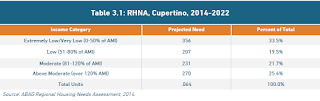


I wonder what is the city's action plan to fulfill that 50% requirement in each income level so that we are not subject to SB 35 next year. In other words, what is our action plan to approve and permit 178 EVL/VL units, 104 Low units, and 116 Moderate units?

What options we have and what financial burdens each option will put on the city and taxpayers?

If the city has studied this issue and has an action plan, please point me to any such document or meeting minutes.

I've looked through the Housing Element and I couldn't find a clear plan to provide the BMR housing numbers in the RHNA allocation.

From the Appendix B of Housing Element Technical Report, I see that the city marked every site in Scenario A as "Very Low/Low":
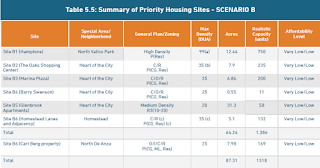

The city has approved Hamptons and Marina projects, total 600+188 units. But they only provide a small fraction of the "Very Low/Low" units. So, I wonder whether the city has a plan to actually provide BMR at all income levels in RHNA requirement?

I noticed the letter at the end of Appendix B from Low Foundation of Silicon Valley. The letter points out:
  • There is no analysis as to why housing production in Cupertino for low-income individuals and families fell nearly 90% short of its affordable housing allocations under the past planning period's RHNA.
  • In general, the qualified objectives and housing programs currently in the Housing Element lack specific time frames or actions, and require changes to make them effective tools for development.
  • The Draft's programs lack meaningful timeframes, which makes it difficult to determine whether the programs will have beneficial impacts during the planning period. State law requires that the Draft contain programs that set forth a schedule of actions during the planning period, each with a timeline for implementation, such that there will be beneficial impacts of the programs within the planning period. (Government Code § 65583(c).)
  • Cupertino's programs also lack clarity and specificity, which makes is extremely difficult for members of the public to understand what steps Cupertino will take to achieve its goals and how and when the public can engage with Cupertino staff. Per HCD, "programs must include a specific time frame for implementation, identify the agencies or officials responsible for implementation and describe the jurisdiction's specific role in implementation." (Housing Programs: Conserve and Improve the Existing Housing Stock, Required Components of Program Actions, http://www.hcd.ca.gov/hpd/housing_element2/PRO_conserve.php.)
Looking through Chapter 4 Housing Element and Appendix B Housing Element Technical Report, I did not find any "specific time frame for implementation" or "actions" to deliver the "356 extremely low/very low-income units, 207 low-income units, 196 moderate-income units" within the 8 years of Housing Element cycle.

Thank you for your attention to this matter.
Now that several 2017 pro-housing laws, including SB 35, have passed, I wonder what's the city's plan to fulfill RHNA requirements? What has been done? What's planned for 2018 or the next 4 years, remaining in the current HE cycle.

Sincerely,

Liang
Cupertino Resident

Monday, December 1, 2014

Systemetic Overestimation of Very Low and Low income and Underestimate of Above Moderate income housing, by Randy


Randy points out that
"there has been a systematic overestimation of Very Low and Low income housing unit production and a systematic underestimation of Above Moderate income housing unit production."

"I believe the use of Government Code 65583.2(c)(3)(B) is inconsistent with Government Code 65588(a) because it can be demonstrated that the use of 65583.2(c)(3)(B) produces consistently erroneous results within the City of Cupertino."

"You have an obligation to follow Government Code 65588(a), because if it can be demonstrated that you were aware of a problem, and that you did nothing to correct it, it might have legal implications. For instance, some housing advocacy group might decide to sue the City for not meeting its RHNA goals for lower income housing. They might argue that the City selected an estimation method that allowed the City to shirk its responsibility to provide lower cost housing."

"Why is this important? Because if the City knows that there will be a shortfall in the number of lower cost housing, it can start to plan mitigation measures sooner rather than latter. The other reason is that the systematic underestimation of the number of Above Moderate income units produced result in more overall housing units being produced."

--------- Forwarded message ----------
From: Randy Shingai
Date: Mon, Dec 1, 2014 at 11:48 AM
Subject: Government Code 65588(a) should trump use of Government Code 65583.2(c)(3)(B)
To: City Council <citycouncil@cupertino.org>, City Clerk <cityclerk@cupertino.org>, "dapaul@darcypaul.org" <dapaul@darcypaul.org>, Savita Vaidhyanathan <savita4council@gmail.com>


Dear Sirs:
This is regarding the draft Housing Element for 2014-2022 that was made available for the December 2, 2014 Regular Council Meeting, and follows up an earlier email.
Here is Government Code 65588(a):
65588.  (a) Each local government shall review its housing element
as frequently as appropriate to evaluate all of the following:
   (1) The appropriateness of the housing goals, objectives, and
policies in contributing to the attainment of the state housing goal.
   (2) The effectiveness of the housing element in attainment of the
community's housing goals and objectives.
   (3) The progress of the city, county, or city and county in
implementation of the housing element.

I believe the use of Government Code 65583.2(c)(3)(B) is inconsistent with Government Code 65588(a) because it can be demonstrated that the use of 65583.2(c)(3)(B) produces consistently erroneous results within the City of Cupertino.  The City of Cupertino uses Government Code 65583.2(c)(3)(B) to project that high-density housing will produce only lower income housing within the City of Cupertino.  Recent and past history has shown that high density housing rarely produces lower income housing units within the City of Cupertino.
While the City is allowed to use Government Code 65583.2(c)(3)(B) to calculate the number of units that can be used to fulfill its share of the regional housing need for lower income housing, the City is not required to use 65583.2(c)(3)(B). Cupertino can instead use a more conventional approach.  That is the approach described in 65583.2(c)(3)(A).
Here is Government Code 65583.2(c)(3):
   
(3) For the number of units calculated to accommodate its share of
the regional housing need for lower income households pursuant to
paragraph (2), a city or county shall do either of the following:
   (A) Provide an analysis demonstrating how the adopted densities
accommodate this need. The analysis shall include, but is not limited
to, factors such as market demand, financial feasibility, or
information based on development project experience within a zone or
zones that provide housing for lower income households.
   (B) The following densities shall be deemed appropriate to
accommodate housing for lower income households:
   (i) For incorporated cities within nonmetropolitan counties and
for nonmetropolitan counties that have micropolitan areas: sites
allowing at least 15 units per acre.
   (ii) For unincorporated areas in all nonmetropolitan counties not
included in clause (i): sites allowing at least 10 units per acre.
   (iii) For suburban jurisdictions: sites allowing at least 20 units
per acre.
   (iv) For jurisdictions in metropolitan counties: sites allowing at
least 30 units per acre.

The City of Cupertino used 65583.2(c)(3)(B) to estimate the number of lower income housing units that would be produced by its inventory of suitable sites for housing in its 2007-20014 Housing Element.  According to Table 7.2 in the draft Housing Element Technical Report for 2014-2022, the City achieved 7.3% of its Very Low and 10% of its Low income RHNA goals for the preceding 2007-2014 RHNA period, while at the same time achieving 164% of its Above Moderate income RHNA goals up through 2013.  So it's fair to say that there has been a systematic overestimation of Very Low and Low income housing unit production and a systematic underestimation of Above Moderate income housing unit production.  I believe the use of  65583.2(c)(3)(B) is responsible for this.

In the draft Housing Element Technical Report for 2014-2022, Tables 5.1 and 5-2 inventory a total of 1,389 possible housing units that can be constructed on 6 sites.  Every one of these units are projected to have an Affordability Level of Very Low or Low. If these projections are even half correct and these sites are all developed in the 2014-2022 time frame, then the City of Cupertino should easily meet its Very Low and Low income RHNA goals for 2014-2022.  However, any reasonable person would doubt that this is going to happen. 
 
You have an obligation to follow Government Code 65588(a), because if it can be demonstrated that you were aware of a problem, and that you did nothing to correct it, it might have legal implications.  For instance, some housing advocacy group might decide to sue the City for not meeting its RHNA goals for lower income housing.  They might argue that the City selected an estimation method that allowed the City to shirk its responsibility to provide lower cost housing.
 
Why is this important?  Because if the City knows that there will be a shortfall in the number of lower cost housing, it can start to plan mitigation measures sooner rather than latter.  The other reason is that the systematic underestimation of the number of Above Moderate income units produced result in more overall housing units being produced.
 
Please make this part of the public record for the December 2, 2014 Regular Council Meeting.
 
Thank You,
 
Randy Shingai